
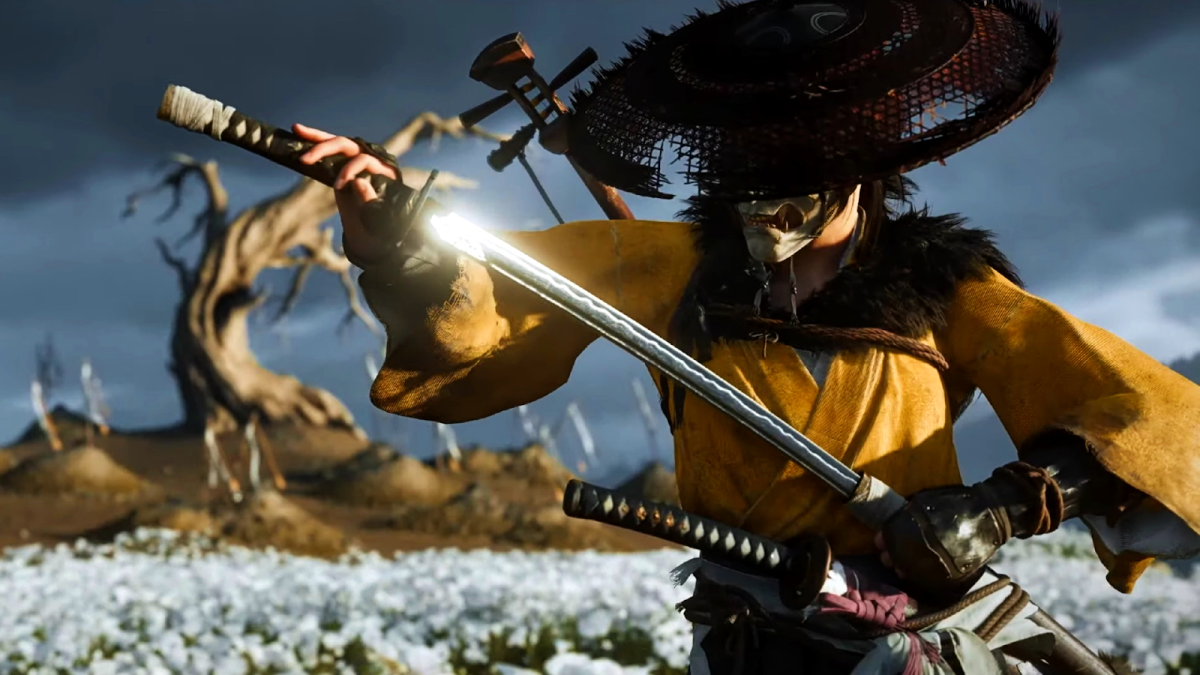
“Ghost of Yotei” is a technical masterpiece, an action-adventure sequel that truly honors its roots. “Ghost of Tsushima”, its predecessor, hit shelves to overwhelmingly positive critical acclaim. For its creators, the action-adventure game was a landmark release. People loved the satisfying combat, the poignant narrative, the painterly visuals and vast open world. With one Game of the Year nomination under their belt, “Tsushima” had asserted itself as a modern classic. A sequel was absolutely inbound, and it had a lot to live up to. After five years in development, “Yōtei” was released this October.
It’s 1603, in a place known colloquially as Ezo, now modern-day Hokkaido. Atsu’s entire family was slain in cold-blood by Clan Saito over old wounds, and after sixteen years of fighting in Southern Japan, she’s come back to her homeland to exact revenge. As our perspective character, the game models itself off of Atsu’s journey, the genre specificities of a wandering samurai. The game puts a lot of emphasis on individuality of experience and pacing. Discovery is innate, the world feels lively. I loved it, even if there were a few slight hitches. There’s so much care and kindness to be found in this work of art.
The vengeance is poignant. Before anything else, I was faced with that loss. Be that as it may, the narrative has a few major issues, especially with commitment to that purpose. It’s the natural arc of the story for Atsu’s values to shift, but it’s simply not very satisfying. The ideas it’s trying to convey are executed, just not in a way that feels fully natural. Thematically, revenge is the story’s metaphor for grief. They comment on how she’s lost herself in the hunt, play subtly into the tragic fact that she doesn’t plan on living past this fight. Atsu, in the end, wants this revenge to kill her, but gaining newfound connections changes that.
When the arc starts to resolve, it feels like a lack of loyalty to Atsu’s own conviction. To me, there was never truly an earned full-circle moment. It got muddled, foggy, the emphasis was in the wrong places. The way the story’s moral compass judges her is uneven, too. Some people hold Atsu in contempt for underexpressed reasons, and they don’t confront her in ways that ask any meaningful questions. There is a lot to dwell on, but it can often feel like an afterthought.
It is an effective narrative, but it takes all the strength it has to stand on its own. There’s a lot of meaning to be found, the characters are complex, but not without some internal confusion along the way. It’s like gaussian blur over some very, very key moments. Some things should’ve hit harder than they did in the end, some punches wind up more than others.
Even if I didn’t always match the emotions being expressed, I always felt they were real. That’s thanks to Erika Ishii, the actress who plays Atsu. She made me believe all of it. Their cadence is low, smooth, and intimidating. They play her just like who she is; a guarded, versatile warrior. The warmth of the forge that made her still shines through, even though she’s long-since grown sharp, detached. Someone who’s been hurt beyond belief. That performance was a major contributor to my adoration of this game. I love Atsu because of Ishii’s fantastic work.
Much like “Tsushima”, the game’s namesake comes from an existing landmark, the titular Mount Yōtei. All of “Yōtei’s” world was inspired by and modeled after real history. To me, Ezo was the true highlight of the experience. The visuals felt like walking through paintings, each new section a brand new splendor, all unique. It’s responsive, there was no shortage of new things to discover. I could just pick a direction and go, it wouldn’t be long until I got distracted. I found a thousand detours. Dueling, petting wolves, following screams in the woods. Saving lives, winning fights, solving puzzles, the magic of Ezo. I got lost, but I wasn’t guideless. “Yōtei” wraps around the player, meets them at every turn with something new and bold.
It’s all tailored by the choices Atsu makes along her path, the world shifts to meet her on her way. Everything she does builds up the mythos behind her story, the people believe she’s an “onryō”, a spirit resurrected from the dead to enact gruesome revenge. Expand enough, and some enemies will grow terrified of her mere presence. More and more bounty hunters try to chase her down, very few get away alive. Atsu is vicious, and what embodies that is “Yōtei’s” gameplay.
The combat is even more fluid than the first. A lot of sequels scrutinize over needless, small changes in the essential fabrics. It’s a symptom of deficit confidence, but “Yōtei” never struggles with that. They know what works, and they utilize it perfectly. Unlike “Tsushima”, Atsu has no code of honor to bind herself by. The player isn’t a samurai this time. Atsu doesn’t have a name to uphold, just wrongs to right. She fights bloody, recklessly, terrifyingly, and that opens up a world of possibilities. Nothing’s beneath her, so she’s incredibly versatile.
Throughout the game, I’d use every weapon I could get my hands on. That’s how the developers chose to expand the combat, and it works amazingly. Every new tool serves a specific function, a method that fights the best against certain enemies. Atsu harmonizes her tools, which forces the player to operate the same way she would. The game moderates that creative tension phenomenally, always keeping Atsu on her toes. It takes mastery, but it couldn’t be more fluid and creative. I could jump in, fight, and always end up wanting more. Well, most of the time.
The gameplay blossoms in group combat, managing the player’s attention, crowd control; it’s what it was built for. The variability is the fun of it. The bosses, however, need some tweaking. On every difficulty but the easiest, they’re blunt and thoughtless. The tricks they play are crass, sardonic, and they don’t leave room for Atsu’s trademark adaptability. Most duels leave that up to the player, but not them, the very people Atsu goes this far to kill. I played on one of the harder difficulties, and every mainline duel felt streamlined to me, lacking room for iteration. They must be balanced, they need to be more responsive and fair. “Tsushima’s” bosses were incredible because they always felt even. It was a matching of ability, not a test of endurance against an impossible torrent of sudden, unblockable attacks. There, the player could always find a way to study, strike back, take clean cuts. On “Tsushima’s” highest difficulty, duels could happen in seconds. A quick passing of blades, a moment’s notice, and someone’s dead. It’s the only way Yōtei is unfaithful to its roots.
In the end, “Ghost of Yotei” is a stunning, highly enjoyable experience. It was an honor to play it, the artistry behind it is passionate and impressive. The visuals were breathtaking, the combat was incredible, and the story was emotionally very hard-hitting. Even with the sparse issues, I’d play it a thousand times. It’s a sequel that never fails to honor its roots, and yet it stands on its own beautifully. If you love vibrant worlds, vengeance, involved combat and Japanese fiction, “Ghost of Yotei” is for you.